Showing posts with label Projects 9-15. Show all posts

Sunday, 8 May 2011

Project 14: An organised event

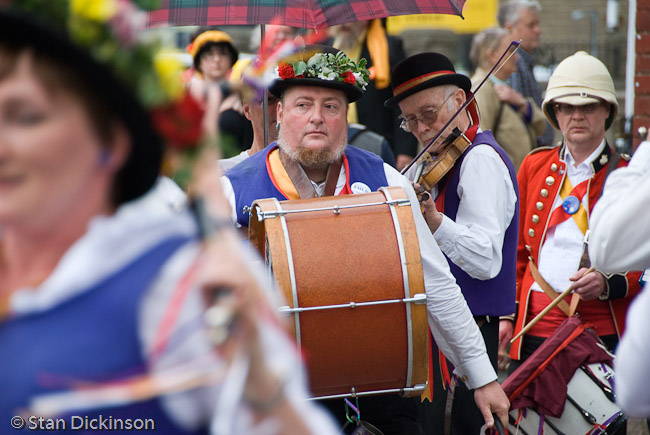
I spent a large part of yesterday taking photographs at the Holmfirth Festival of Folk, an annual event that takes place over an early-May weekend around the streets and venues of Holmfirth.  It’s a big event with a lot going on, so I made the decision to concentrate on what was happening outside rather than going into the pubs etc where performances were taking place inside.  As the brief on ‘Structured situations’ says, this is about ‘explaining’ as well as finding telling moments.

Setting the scene right from the start, the ‘outside’ element of the festival involves people dressing up in colourful fashion and dancing/performing in public spaces – and having/giving fun, of course.

The performers come in all shapes & sizes, and from a photographic point of view, one can capture general scenes, such as the one above, or this one.

Or, there are opportunities to go in close and capture the performers faces in various states of concentration or performance, as these.

In the ‘explaining’ context, both of the above are self-explanatory, but I also took this one of a young man seemingly concentrating hard on what he is doing, but there are few, if any, clues as to what it might be.

He was performing along with a number of colleagues, and I did take a picture of the group, but they were all dressed black, performing in a line, with relatively little body movement involved, so it wasn’t especially interesting.  However, if his head and shoulders shot is combined with a detail image, such as the one below, it all becomes clear, and in a visually interesting way.

There are outdoor musical performances, as well as dance.
Though sometimes, these performances produce impromptu engagement by members of the audience.
And, picking up on the audience theme, that is a crucial part of the explanation of an event such as this.  The audience is present in a number of the above images, of course, but there is opportunity to turn the camera on them specifically, demonstrating the varied nature of the watchers, and also their reactions to events.


The audience pictures could be ‘portraits’ or groups such as those above, or they could be more general ‘crowd’ scenes ‘scene-setters’ so to speak.  This one includes part of the town and the streets, so providing a contextual aspect.  Pity that the church was covered in plastic this year, but nothing I could do about that.

Of course, there are opportunities to include ‘mini-narratives’ within the overall context.  One might follow the image above with the following ‘story’.


Actually, I realised afterwards that I hadn’t captured the end of the story!  Which is, of course, that he caught it!

The event ends with a parade of the performers.  I had not intended to stay for that, and capturing it properly means picking the right spot(s) along the route where you can get a clear enough view to get the right images.  However, I did watch the start, and these, although not well-planned in terms of positioning, add some further colour and flavour to the overall series.


Great fun – and it is a splendid event to photograph.  I have put a lot of pictures into this series because it was necessary to give a full explanation.  The project brief doesn’t specify a number and so I have not been as selective as I might (though I did take over 100 images in the day).  Picking, say, eight or ten would be quite a challenge, and I’m not going to spend time doing it, since I don’t need to!!

One other thing – I probably didn’t satisfy my tutor that, in Assignment Five, I had done enough ‘explaining’.  This project has, I hope, given an opportunity to explore that side more thoroughly.

Monday, 2 May 2011

Project 15: Public space, public activity

There are two projects from section two of the course that I have not yet completed/written up.  Project 14: An organised event has been waiting for a suitable event, and is planned for next weekend, but this entry is intended to cover Project 15: Public space, public activity.  Actually, I think Assignment Two and a lot of the images that I took around the process of completing that assignment have pretty much covered this topic, and I’m not going to spend time doing further ‘public space’ sessions.  I will though just bring together a few images that were not necessarily part of the submission/planning for Assignment Two, but which illustrate the ideas mentioned in the brief for this project – “how people make their own personal or small group activities within the same general area” – though I stress again, the ‘personal space’ in ‘public space’ was very much part of the theme in Assignment Two anyway.

There are six or seven people grouped very closely together in a confined space in this shot, yet in very few ways are they interacting with each other or even showing apparent awareness of each other.  We have two young men on the left, probably in conversation as one smokes a cigarette; one young man sitting very close to them, also smoking, but concentrating on his phone; just far enough away to be separate and clearly interacting, is another couple, also looking at a phone; and finally, another young woman sits close by eating her lunch.  Not nearly as good, but I’m sort of reminded of the Garry Winogrand photograph of a group of people sitting on a bench – ‘World’s Fair, New York City 1964’.


These three are quite similar, indeed the first and last are taken close together, as the background in the last one shows.  The next one is a familiar activity in city centre environments.
And, finally, here is one showing a very different activity.  These people were busy making a film.
As I said above, I’m not going to spend any further time on this project because I think I’ve done enough over the last couple of months to explore the activities of people occupying public space.

Sunday, 20 February 2011

Project 13: A standard view

I’ve been through the question of ‘what is standard length’ before, both in TAoP and ItDP.  It’s probably somewhere in 30mms for my camera, but when it is interpreted as whatever makes the scene through the viewfinder and that with the naked eye look the same, it seems to get a bit vague.  Interpreting this project in the way that I think it is meant to be interpreted, I have been a little flexible, but looked primarily around the 24-44mm range, which is 36-66mm in full frame terms.  More to the point, these are images which, as the notes say, have the feeling of ‘normality’ about them – none of the flattening and unusual juxtaposition of planes associated with the telephoto lengths, and none of the visual distortion just noted in Project 12.
A standard focal length can be very effective as a simple ‘scene-setter’, as in these next two images.
Both are taken at around the 35mm point, and both give a ‘natural’ impression of the scene on view – particularly the first one, I feel.  The relationships between foreground and background look ‘normal’ and there is no distortion at the edges of the frame.
Introducing a more specific subject into the image, at standard focal lengths, also retains this naturalness.  The relationship between that subject and the rest of the items in the frame feels acceptable to the human eye, and any reaction is to what is being presented rather than, say to the sense of drama created, for example, by a close in/wide angle.
It is still possible to present something with a narrative quality to it, of course, but the viewer’s attention will be more likely to focus on that narrative alone, rather than visual issues created by the camera.  The following image is perhaps pushing things a little in the context of this project, being at around 36mm full frame equivalent, but it does not have major foreshortening or distortion.  What it does, hopefully, achieve is the creation of a relationship between elements of the image that did not exist in reality, but are in fact created by me pressing the shutter and framing them as I did.
Of course, the standard length can also be used to take natural-looking images of people, from a reasonable close distance.  The first is probably more towards the telephoto length, being 44mm on my camera, but doesn’t seem to distort to any great degree.
The second, below, is clearly not a shot of ‘people unaware’ but it has got to be worth a place here!  I met these two (or rather they introduced themselves to me) as I was returning to my car after last week’s Manchester shoot.  They asked me if I’d like to take their picture, so I agreed – here is the result!

Friday, 18 February 2011

Project 12: Close and involved

I suppose that I’ve kind of done this project back to front.  When I started out on ‘People Unaware’, I did a lot of wide angle, up-close-and-personal shots because it was those that concerned me most. Latterly, I think the quality of what I have done for the other projects has improved, and I feel a bit disappointed when I look back at some of the images for this project.  That said I don’t feel the need to go back and do more work at this stage.  I think I’ve learned enough to be able to make effective use of this approach, as necessary, in future projects/assignments.  I might drop other examples into this part of my learning log as and when they arise.
These two early examples showed how the wide angle, particularly when combined with a low angle, can create quite a dramatic effect and really pull the viewer into the scene.
The composition and exaggerated perspective of the first highlights the two key subjects and makes for an interesting, if technically deficient image.  The second has some movement and life about it, even if the subject matter isn’t up to much.
Three other, more recent shots offer some improvement in technical quality.
The first has been discussed at some length earlier in my blog, and all three still ‘suffer’ from the low angle distortion, but I think that it adds to the interest in all cases.  The character in the yellow shirt and shoes is making a strong statement in the way he is dressed, and this image builds on that (maybe satirises it) by making him ‘big’ in the street.  There is a similar superior look about the two characters in the third image, which I think is well served by the wide/low angle.
The next two use the wide angle in a way that also brings in the broader background scene (and are also taken at a more ‘natural’ camera level).  The first suffers from the technical deficiencies that I have already discussed, but the second has more of the New York street shot feel about it.  Unlike the detached sense that comes across in the images in Project 11, we are there, on the street, close to these two women as they pass, whilst also aware of the broader environment, the architecture, etc.
All of the above shots are taken with a compact camera.  The quality improves significantly again, when I switch to the DSLR and a 10-20mm wide angle lens.  I have used these two shots before, but they are good examples of the ‘Close and involved’  principle.
It is perfectly possible, with this wide an angle, to take pictures of people very close to them without them even being aware that you are including them in the frame – within reason, of course.  But one of the major disadvantages of this approach, as mentioned above, is the degree of distortion that can result.  It is certainly evident in the two individuals on the left edge of the second image.  Then again, sometimes that can be used to good effect, when a dramatic angle is part of the impact of the image.  Again, I can illustrate this with an image already discussed earlier in this log.
So, involving the viewer in the scene, creating dynamic impact, getting close to people without them knowing they’re in the shot, including foreground subject plus the whole of the background in the same image, all of these are potential advantages of working with a wide angle.  Upsetting a subject by being too close and being noticed, together with the distortion and issues around getting the right focus when taking a shot quickly, are all potential problems.  Once again, the work over the last few weeks has opened my eyes to the possibilities, but I think there is still more work to be done to really put this approach to its best possible use.

Project 11: Standing back

Use of a telephoto length lens has played at least some part in most of the ‘unaware’ sessions that I have had over the last few weeks, but yesterday I spent another three hours on a ‘street’ shoot in Central Manchester, with three aims – to principally concentrate on creating images at longer focal lengths for this project; to also take photographs at ‘standard’ length; and to further explore the idea of ‘eating in public’ as a possible ‘activity’ for Assignment Two.  (On the latter issue, I have also discussed it with my tutor and have definitely decided to go that way.  Planning the approach needs to be done soon.)  It was a successful session, and I think that I have now spent enough time trying out the three focal length variants and intend to bring that work together in here over the next few days.
Beginning with Project 11, I am going to present some results in the context of the question that appears at the end of the brief.  ‘... what creative opportunities do you find that a long focal length and distant position have given you?’
The first, and perhaps most obvious, is that it enables you to record, almost at an intimate level in some cases, what you can only reasonably observe at a distance.  Comparing that to the results from a wide angle lens that will follow later, the latter really makes the viewer feel close and involved in the action, with a sense of movement and the wide angle distortion giving the image a life of its own, whilst the telephoto lens does give you a close view of the interactions between people, for example, but in a more detached, observational, non-intrusive, but somewhat calmer manner.  For example in these images:
In both cases, we are able to observe the interaction in a way that normally, without the camera, could only be achieved by standing close to these people.  Standing that close with the camera could be even more difficult in some cases.  So another advantage of working with the long lens is that it opens up the opportunity to create images that would probably be otherwise impossible.  These next two are good examples of that circumstance.

The second of these also introduces another significant creative benefit of the telephoto lens in ‘street’ situations.  As well as keeping the photographer away from potentially intimidating situations, it also, because of the flattening of three dimensional space, enables one to juxtapose subjects that are, in reality, some distance from each other and not in fact either related or interacting – in this case the character with the bottle of Lambrini and the newspaper hoarding.  These images illustrate the same principle.  In the first case, the image creates a relationship between the watchers in the crowd and the two figures looking out of the window.  In the second, which could be much better composed if time and circumstances had been more favourable, a relationship is created between the shop sign, the girl outside the shop and her blue check jacket, the man in the blue check sweater, the flower stall, and the woman in the foreground.

Working with a wide aperture and a telephoto length lens offers another creative variation on this theme.  As well as enabling image creation in indifferent light (this was shot with an 85mm lens at F1.8, on a late, dull winter afternoon), by use of the differential focus and the shallow depth of field, it is possible to particularly draw the viewers’ attention to a key subject that one is trying to present.  The young man in the background is almost obscured by the figure in the foreground, yet the eye is drawn specifically to him by the difference of focus (plus the colour, and the highlighting of his face).
This project is entitled ‘Standing back’, of course, and the following images, some of them using principles already discussed, demonstrate how the telephoto length will give the viewer the sense that they are ‘standing back’ from what is being presented.
I particularly like the way in which the flattening of the planes of the final image almost give the feeling of a tableau or stage set situation.
This has been a really useful exercise.  I have taken a lot more photographs than the ones illustrated here, and many have failed because someone has walked between me and the subject, or the moment has passed whilst I’m waiting for the scene to clear of people, etc, but I think that I have emerged with a much better appreciation of the possibilities with longer focal lengths.