Showing posts with label Projects 19-23. Show all posts

Sunday, 13 November 2011

Project 22: Adjusting the balance between person and space

These two images were both taken in the same location – Conwy, North Wales – during the summer.  I must admit that it was Project 21, making figures anonymous, that I had in mind when out with the camera that morning, but I think these two demonstrate the principle of Project 22 more effectively.


The first is very definitely the picture postcard image of a row of Welsh cottages adjacent to the ‘smallest house in Britain’.  John Hinde would have been proud of me!  There is a figure in the frame – walking into it and providing some scale – but it is essentially an image about place.


In the second, the emphasis has changed quite dramatically.  The figure is in the foreground and therefore takes up more of the frame; the cottages are slightly out of focus; and the figure is doing something, namely speaking on a mobile phone.  The combination of the silver hair and the modern gadget adds another slight twist.  This second image is, I would suggest, much more about narrative and provokes much more questioning for the viewer.  It would be an unlikely image for a John Hinde postcard!

Project 23: Selective processing and prominence

Another piece of catching up that I need to do – completing and writing up some of the projects from Section 4 of the course.  One or two of them still some photographs taking, some like this one just need processing and writing up.

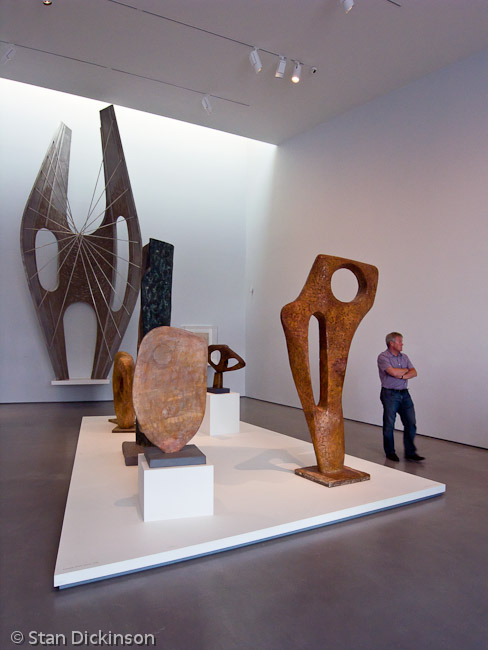
This project says produce two versions of the same image but use selective processing to alter the balance and prominence between a figure and its surroundings.  I have chosen this image that I took a few weeks ago in the new Hepworth Gallery in Wakefield.  A single figure is standing beside a selection of Barbara Hepworth pieces, though at the same time seeming to ignore them.  I’m actually going to show four different versions and the first version is a relatively ‘neutral’ one, more or less ‘as shot’.


Certainly the pieces of sculpture dominate the frame, but the figure of the man could be said to be more or less ‘in balance’ with the piece next to him.  In the version below, the figure has been lightened significantly and becomes much more noticeable.  If the first image might be a, illustration from a magazine article about the gallery or about Barbara Hepworth, one kind of feels that, in the second, the man is the curator, or the gallery manager or the architect, or some such.


Taking the principle and reversing it, we have the version below.  The background remains the same in all three of these versions but in the third the figure has been darkened, shifting the emphasis entirely towards the art works. With the man offering little other than a sense of scale.


I did also try pushing the balance further, about as far as I could – by darkening the background and lightening the figure, with the following outcome.


Pushing the relative balance much further than this begins to produce a surreal effect .

Monday, 29 August 2011

Project 19: A single figure small


Have been working on some of the projects in section four of the course whilst planning the fourth assignment and it’s time I wrote some of that up here.

My first example of a ‘single figure small’ is the classic isolated individual silhouetted as they walk across an empty landscape.  This image would be more or less worthless without the figure, and it could be argued that the figure is a bit too small.


Personally, I don’t mind it on this scale.  I feel that it really does give a sense of the wide open space in which this individual is walking.  The contrast between the dark figure and the light coloured sand is important, of course.  An alternative crop might be much tighter, for example.  The water in the foreground could be said to isolate the figure even more by seeming to leave them stranded on an island of sand.


Sometimes you need to have a small figure in the image just to define the scale of what the viewer is seeing.  Once again, in the example below, the figure is very small in the frame, and dressed in dark colours against a dark background.  Presented small in this log, it might be almost impossible to tell that she is there – but, in line with the comments in the notes, there is at least the element of surprise when the viewer does spot her.  The presence of the figure certainly does define the scale, which could be very confusing without it.


I’m also going to include a couple of examples where the figure is much less insignificant in size – still small enough to be anonymous, but big enough to be seen clearly.  I would suggest that, in both these cases, it is the presence of the figure, and their interaction with the environment (and the frame?) that makes the image into something remotely interesting.


A good and effective principle that has both compositional merit and the potential to fundamentally affect the narrative quality of the image.