Sunday, 18 December 2011

Assignment Five – more background & thinking

As I said in the last post, the idea for this project came to me some years ago.  Coincidentally, about six months ago, there was an article on the Guardian website about a project that Martin Parr had done for Oxfam, which has some similarities with what I have in mind.  The article is here.  In Vietnam, he photographed local people with something that they regarded as sufficiently precious to ‘save’ by taking it with them to a higher part of their dwelling when the floods came. This led to a project back in the UK, where he photographed ‘celebrities’ with whatever they would choose to save in the event of a flood.  Not surprisingly, there are interesting differences between the two groups, with the Vietnamese showing a strong preference for identity cards, school books and means of cooking rice, whereas the Celebrities favour laptops, diaries, sketchbooks and the like.  That said; paintings, photographs & other images crop up in both groups.

Of course, my interest in the Parr work is less about what it says and more about the way it goes about saying it.  The style of the portraits is, on the whole, simple – a basic front on pose, standing, facing the camera, usually holding whatever it is they choose to save.  The faces are unsmiling, quite deadpan, not expressing any obvious emotion, but they work as portraits – as simple expressions of these peoples’ personalities and lives, rather less self-conscious in the case of the celebrities, unsurprisingly.  The Vietnamese images look as though they have mostly been shot in natural light whereas the celebrity shots have the characteristic Parr ‘ring-flash’ look (I think).  Very early in this course, I looked at Avedon’s portraits and read about his method.  I think of the famous image of the young boy with a rattlesnake - here - the pose is similar but the outcome is something much harder.  I don’t think I’m in the business of making Avedon-like portraits and the Parr approach is probably a better model for me.  I do, though, want to try and explore the story, the narrative of the emotional link between this person, the object, maybe the place, and certainly the childhood that the object represents.  I’m setting myself a very tough task trying to get all of that into a single portrait – it’s probably impossible, but I feel that it’s worth having a go.  There is something to learn from stretching oneself and looking at what results.

I have also been looking through some of my books for elements of ‘theory’ that might relate to what I’m doing.  One piece that certainly struck a note was in ‘Photography: a Critical Introduction’ ed. Liz Wells.  In Chapter 5 ‘Spectacles and Illusions’, page 221 talks about the ‘Grammar of the Ad’.  It refers to Barthes’ ‘denoted’ and ‘connoted’ messages, and the potential significance of the latter in advertising.  My brief, as I have written it for myself, is to produce images that may be used in advertising and, in any case, the notion that there is communication going on at different levels is an interesting one.  The ‘denoted’ messages, supported by the accompanying text, will be the specific stories of the relationships between these people and their retained objects, but the ‘connoted’ messages, if I do my job effectively, will be to do with the way in which we are all products of our childhood experiences.  In Maria Short’s ‘Context and Narrative’ about which I wrote in here a few weeks ago, there is a chapter on ‘Signs and Symbols’.  Amongst others, it features work by Emma Blaney entitled ‘The Spectre of the Impossible Desire’, in relation to which there is a reference to “... the meaning that is often invested in small everyday objects...” as “... triggers for deeply embedded memories ...”.  Somewhere in here, I feel, is a theoretical context for the work I want to do in this assignment.

·         The memory and emotion triggered in the mature adult by the object that they hold, touch or look at, which they also held, touched and looked at when they were a child;

·         The presentation of that relationship and its emotional implications in the image;

·         The context of the relationship, as presented, which includes:

§  ‘place’; the location or background;

§  The style and physical qualities of the image;

§  Text which will accompany the image;

§  Nature and quality of media;

§  Inevitably, the reading of the signs in the image – by the viewer;

·         And so, the connoted message(s) about childhood experiences and their relationship with the adults; and, in the context of advertising, the resulting action that the advertiser seeks.

When I start analysing the possibilities to that degree, I start to find the whole thing somewhat daunting; but I think I need to keep my feet on the ground here and not try to be too ambitious.  Or at least I need to keep a range of options open.  Back to the Parr work with Oxfam and its relative simplicity – it will perhaps make sense to take at least one version of each portrait that follows this type of simple approach.  That way, if other experiments fail, I at least have the potential for some consistent and usable images.  This also fits with my thinking early on in the course, when I was favouring the contemporary ‘deadpan’ portrait style.  The best option will be, I think, to try out a few versions of each but to always make sure I have at least one that is – front-facing; looking into camera; unsmiling; deadpan; holding the object; etc.  Trouble is – will that explore the emotional aspects that I’ve listed above?  This isn’t going to be easy!

Another angle on what I’m planning in this assignment is the use of text.  Each image will be accompanied by 50-100 words that encapsulate the story.  I am kind of conscious that this could be interpreted as a ‘cop-out’ – the text doing the work that I should have done in the image!  That shouldn’t be the case.  The image must contain enough ‘signs’ for the viewer to form a ‘message’ in their mind and to be drawn to read both itself and the text.  There is a whole chapter in Short’s book on the use of text and I also need to look at Barthes’ ‘The Photographic Message’ where he discusses this relationship.

Above all, though, important as it is to consider the theoretical context of the assignment, I want to produce a piece of work, images and text, that I feel enthused by; something that expresses the interest that I feel in exploring this particular subject area; something, also, that picks up on the interest that has come back from the people with whom I have discussed the project.  I’m actually writing this after completing my first session with a subject, though much of what I’ve said above was going around in my mind before.  The first session has confirmed that getting everything right is going to be a real challenge.  It has even made me question my own ability to carry this off at a technical level.  However, I am keen to see this through, so ‘onwards & upwards’ as they say.

Monday, 5 December 2011

Assignment Five – the background and the brief

I have a direction and a brief for my final assignment.  The course brief is open-ended, of course, but essentially boils down to – writing yourself a realistic client brief; completing the brief by producing 8-12 images; submitting with an appraisal/analysis of what you have done.  I have decided to base it on a photographic project idea that has been in the back of my mind for 2-3 years and which seems to fit very well into this context.  The project actually has the potential to go on developing beyond the assignment as well.

The idea came about when I was studying Introduction to Digital Photography and used part of an old photo of me as a child in the ‘Real or False’ Assignment.  Digging out the old photo, plus some other items from my childhood, led me to think about the type of things we hang onto from our childhood, into adulthood and, sometimes, into later life.  What do we keep?  What does it mean to us and why?  What does it feel like, for example, to hold an object in your hands that you held when you were, say, five years old – maybe even something you created then?  From those kind of thoughts came the idea of making photographic portraits of people in which they were holding (or interacting in some way with) an item that they still have from when they were a child.  I hadn’t done anything about it but when I started out on People & Place and read the open nature of the final assignment, I thought there might be an opportunity.

Of course, the whole idea of the assignment is that it involves creating and responding to a realistic brief.  So I have written one – here:


My tutor has also kindly taken a brief look at it and agrees that it has the potential to fit the bill for this assignment.

I have also given some thought to the theoretical context of the project/assignment, and done some initial research on other comparable photographic work.  But I’ll make that the subject of another blog post.

My first portrait session is organised, too – for the coming weekend!

Monday, 21 November 2011

Exhibitions in Bradford

I managed, recently, to get back to Bradford again, to take a proper look at the Donovan Wylie exhibition that I glanced at during the RPS Event a few weeks ago.  As planned, I was also able to take in the Daniel Meadows show at the NMM, plus a visit to the Impressions Gallery, where I saw two more exhibitions – Red Saunders’ ‘Hidden’ and Jeremy Deller’s ‘Poking About’.  They all had impact, in their different ways, and I have been able to take something away from each.  Having reflected over a few days since the visit, there is a lot I could write up.  I’m going to try and distil things down into a few bullet points here.  I’ll take them in the order that I saw them.

Jeremy Deller – ‘Poking About’

·        Deller is a conceptual artist and this is his response to, or choices as a result of, being asked to ‘poke about’ in the archives of Bradford Museums’ photographic archives – notably, from my own point of view, a collection of thousands of glass negatives from a Manningham Lane photographic studio that was in business from 1926-75.

·        It was the ‘social’ aspects of his selections from the latter, especially from portrait photos from the 1950s, which caught my attention and interest.  That was when ‘affluent’ Manningham Lane changed its characteristics significantly as it was populated by the new immigrant arrivals from Asia and the Caribbean.  The portraits present a fascinating impression of the new arrivals – dressed to the nines for the recording of images to send back to friends and family (one assumes).

·        Often stiff and formal, not much removed from the old-style Victorian portraits with the requisite side table and vase of flowers, they nonetheless present a fascinating narrative.  But of what?

·       All these exhibitions were part of Bradford’s recent photographic festival – ‘Ways of Looking: Evidence’.  These images present evidence that there was a studio on Manningham Lane, which recorded the major change that its neighbourhood went through in the 1950s – but of what else?

·        Apparently the smart suits worn by the men were often loaned by the studio.  There are several images of racial mix – usually Asian man & white woman – but then you see the same woman, in the same clothes, photographed with two different men.  We soon read our own versions of the story into what we look at, but we really have no idea of the ‘truth’.

·        I found this a really thought-provoking presentation, despite its apparent simplicity.  Another excellent example of an artist using the photographic medium in which, on the one hand we are encouraged to look at the photograph as document, with all its connotations of truth and reality, and yet, on reflection, begin to question the whole foundation of what we’re looking at.  It is some form of truth – but about who and what?

Red Saunders – ‘Hidden’

·        Epic-scale prints of ‘supposed’ photographic evidence of significant historical events that have been somewhat ‘hidden’ by the traditional grand narrative of British history, these images are staged reproductions of Saunders’ view of what these events might have looked like, had they been photographed.

·        A few comparisons sprung to mind on viewing this exhibition – advertising posters, especially for epic feature films; the classical tableau paintings; and other modern staged photography, such as Gregory Crewdson and Tom Hunter.  I’m also reminded of other historic paintings I’ve seen recently, such as two images of major historical events in Parliament, which I saw in the National Portrait Gallery.

·        Very carefully staged and constructed, obviously deliberately presented in massive scale for impact and, maybe, credibility, Saunders works are provocative images.  They say, very strongly, look at these events; see them as important aspects of our history.  That’s where the comparison with the two National Portrait Gallery images comes to mind – ‘grand’ paintings that ‘record’ major events in the ‘grand’ narrative.  I’m sure this is what Saunders was getting at with these pictures.

·        Unfortunately, I’m not sure, as presented in this exhibition at least, he has carried it off.  I found them something of a mixed bag in terms of style and presentation.  Perhaps I’m being over-picky, but two of them (Hilda of Whitby & Mary Wolstencroft) have too much of the ‘modern’ feel about them.  I realise that doesn’t invalidate the approach, might even be deliberate, but the Hilda portrait was, for me, a photograph of a young 21st century woman, dressed up in a 7th century outfit.  Apart from the clothes, nothing seemed to say anything else.

·        I wasn’t particularly impressed by the quality of some of the large prints either.  Once again, reflecting back to comments on the Struth exhibition, I find I am questioning the effectiveness of presenting photographic images on this epic scale (see later comments on Donovan Wylie prints).

·        Again, the approach is thought-provoking, but I found myself less convinced of the outcome in this case.

Donovan Wylie – Outposts

·        This series, depicting Canadian military forward bases and operational installations in Afghanistan, follows the photographer’s earlier work on the Maze Prison near Belfast and British Army watchtowers in Northern Ireland.  The images have a ‘bleached’ look about them – partly reflecting the Afghan landscape, I guess, but also in line with the quite muted colours of the earlier works referred to.

·        Scale of presentation is big, but smaller than the Struth and the Saunders, and it works – for me.  I’m guessing that they were maybe 1mx1.25m, comparable, I’d say, with the Simon Roberts’ ‘We England’ images.  Perhaps this is the limit of where we should be pushing photographic prints?  It hardly fits with the artists such as Gursky & Struth, and if they can sell their massive prints at the price they do, good luck to them, but this scale works best for me.

·        When I looked at this series, I wanted to ‘classify’ it as a typography; but then I also wrote ‘... interesting to see it applied in a documentary context’.  So I was sensing some difficulty in ‘pigeon-holing’ Wylie’s work.  Having followed up the visit with some online research of what he has to say about the pictures, it’s interesting that (in an interview at the NMM, available on u-tube) he uses words like ‘scientific’ and ‘functional’ but then says there is an ‘emotional’ aspect as well.  Interesting also, that the book accompanying the Bradford festival describes him as a ‘picturemaker’ and observes that these ‘visual images’ ‘... resonate enough to inspire ... thought and contemplation ...’ because they engage the viewer visually.

·       In the video interviews mentioned above, Wylie also talks about his fascination with the way humans control landscape and about ‘vision as a form of control’ – as in the watchtowers and the manner in which the outposts are watching the landscape.

·       The notions of watching and looking were very much in my mind as I went around the exhibition.  Wylie is looking at ‘looking’.  Some views are of the outposts themselves; some are of the view from the outpost; and then we, as viewers of the exhibition, look at both those views.  In most of the images, nothing is happening, just lots of watching and looking.  Wylie says that he felt a real sense of fear – but I’m not sure that comes across in these images.  For me it was all about this watchfulness.

·       It did provoke an idea for me – in many ways totally unrelated to this subject matter, but relating to the idea of looking at ‘looking’.  When on holiday in Switzerland last year, I was struck by the way in which, confronted by massive world-famous scenery, most visitors, having travelled from all around the world to see it, took out their camera and, standing in groups, took photographs of it.  It was as though the shared experience was the taking of the photograph not the appreciation of the scenery.  Makes me think that there is a project in here – exploring the global concept of ‘looking’ through the camera.  Taking Wylie’s approach, the subject matter might be the cameras, as much as the people or the scene.  That’s a bit of a wild notion – to tuck away for future consideration!

Daniel Meadows – ‘Early Photographic Works’

·        I can’t really do full justice to the scope of this exhibition in a simple post.  I had been vaguely aware of Daniel Meadows before the publicity surrounding the show, but known little about him and never really engaged with who he is. But, I really enjoyed what I saw, at all sorts of levels, and have followed up with further investigation of his website http://www.photobus.co.uk.

·        Some of the resonance is at a personal level, I suspect – the Lancashire connection; the fact I lived through the 70s, when much of this work was done; the link with Martin Parr, whose work I’ve looked at much more.  I think there is also the recognition that a lot of the work he and Parr were doing at this stage was at or just beyond undergraduate level – so there is a sort of a learning/experimenting/searching resonance going on as well.

·        Particularly enjoyable, and worthy of thought for future work, were his ‘Digital Stories’.  Looking at the website afterwards, I realise that this has been a direction for his work since the 1990s – largely, it seems using still images, but combining them together, with voice, music, text etc to create short (2-5 minute) ‘stories’.  Considering that he has been doing this for more than fifteen years, you have to see him as a bit of a pioneer, in the context of the coming together of digital media today.

Sunday, 13 November 2011

Project 22: Adjusting the balance between person and space

These two images were both taken in the same location – Conwy, North Wales – during the summer.  I must admit that it was Project 21, making figures anonymous, that I had in mind when out with the camera that morning, but I think these two demonstrate the principle of Project 22 more effectively.


The first is very definitely the picture postcard image of a row of Welsh cottages adjacent to the ‘smallest house in Britain’.  John Hinde would have been proud of me!  There is a figure in the frame – walking into it and providing some scale – but it is essentially an image about place.


In the second, the emphasis has changed quite dramatically.  The figure is in the foreground and therefore takes up more of the frame; the cottages are slightly out of focus; and the figure is doing something, namely speaking on a mobile phone.  The combination of the silver hair and the modern gadget adds another slight twist.  This second image is, I would suggest, much more about narrative and provokes much more questioning for the viewer.  It would be an unlikely image for a John Hinde postcard!

Project 23: Selective processing and prominence

Another piece of catching up that I need to do – completing and writing up some of the projects from Section 4 of the course.  One or two of them still some photographs taking, some like this one just need processing and writing up.

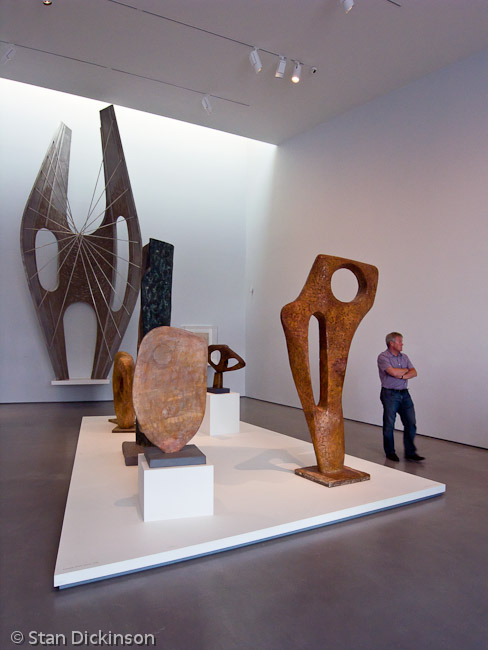
This project says produce two versions of the same image but use selective processing to alter the balance and prominence between a figure and its surroundings.  I have chosen this image that I took a few weeks ago in the new Hepworth Gallery in Wakefield.  A single figure is standing beside a selection of Barbara Hepworth pieces, though at the same time seeming to ignore them.  I’m actually going to show four different versions and the first version is a relatively ‘neutral’ one, more or less ‘as shot’.


Certainly the pieces of sculpture dominate the frame, but the figure of the man could be said to be more or less ‘in balance’ with the piece next to him.  In the version below, the figure has been lightened significantly and becomes much more noticeable.  If the first image might be a, illustration from a magazine article about the gallery or about Barbara Hepworth, one kind of feels that, in the second, the man is the curator, or the gallery manager or the architect, or some such.


Taking the principle and reversing it, we have the version below.  The background remains the same in all three of these versions but in the third the figure has been darkened, shifting the emphasis entirely towards the art works. With the man offering little other than a sense of scale.


I did also try pushing the balance further, about as far as I could – by darkening the background and lightening the figure, with the following outcome.


Pushing the relative balance much further than this begins to produce a surreal effect .

Thursday, 10 November 2011

Some Recent Reading

It has been a while since I recorded any reflections on my reading in here.  It isn’t that I havn’t been doing any – just that I havn’t got round to writing up.

A good place to start would be ‘Context & Narrative’ by Maria Short.  This book was originally recommended by Photography course leader, Jose, on the WeAreOCA blog.  I bought it immediately and have actually read it twice.  It is a book that has the feel of quality about it – well produced, nicely printed (though many of the images are on the small side) and with a good tactile sensation to it (always an important starting point for me when it comes to books!).  Whilst the title might be taken to imply a specialised volume, it is actually quite wide ranging and covers a lot of ground without ever going into a huge amount of depth.  After two readings, my overall reaction is a positive one, but with a few ‘mixed’ feelings.

The book is structured in short sections, with relatively sparse text but lots of examples and case studies – from photographers at all sorts of ‘levels’, students, professionals, well-known names’ and some less well-known.  As I say, it covers a lot of ground and is highly relevant to so many aspects of a degree in photography as a creative art.  Despite the lack of depth, there are so many visual examples that it encourages you to think about the topics in a practical, applied, non-theoretical manner (even though it doesn’t shy away from the theoretical topics).

I would see it as a resource that one could go to frequently, dipping in for ideas and inspiration, but certainly not using it as an in-depth study for a critical review, for example.  I’m glad I’ve read it twice, to know my way around it, but I don’t think it is an easy book to ‘read’.  It isn’t that the concepts are especially difficult; it’s more because it doesn’t develop ideas, rather prompting & then illustrating.  Overall – a good book, a quality publication, and I’m glad I’ve got it; not sure that I have learned a huge amount from it, but useful to go back to, and has the kind of easy reference style that makes it easy to do so.

Some other recent purchases/reads have been designed to try and develop my knowledge and understanding of critical theory.  I won’t be doing the OCA ‘Understanding Visual Culture’ course, but I’d like to improve my awareness of the theoretical background to some degree, at least.  To that end, I’ve recently looked at three very different books.

‘Basic Critical Theory for Photographers’ by Ashley Grange – The title gives a very clear indication as to why I bought it!  Having read a three or four chapters (Berger, Szarkowsi, Sontag & Barthes), I put it down because I was disappointed by it.  I’ve already read the work of three of these four and was hoping for some clarity from this book, some pulling together of the ideas into a sort of summary, but I didn’t feel I was getting that. It does supply and kind of synopsis of each, and it may be that I need to look at it again, but I felt that it read a bit like the notes that one might make from reading, say, Sontag’s ‘On Photography’, rather than something the clarifies and explains her thinking.  It does have practical suggestions for further discussion, and so it might work better as a resource for classroom work.  I’ll go back to it – but disappointing.

‘After Theory’ by Terry Eagleton – This one came up from a recommendation, again, having been referred to by another OCA course leader, PeterH. I’ve skim read it once and am now looking at it again – so this will be a brief comment that I might pick up again later.  Eagleton is more of a literary specialist, of course, but the background on cultural critical theory is perfectly relevant.  More to the point, here is an academic who can write in an authoritative, wide-ranging, but at the same time engaging, and even funny, style.  It is a relatively small book, but the first three chapters give the kind of overview of the development of cultural theory, leading to the postmodern, that is definitely lacking from the Ashley Grange book.  Fundamentally, he is exploring where the cultural critical studies will go after postmodernism; and I have to say that I don’t feel entirely comfortable with his catholic/Marxist dimension.  But, this is a genuinely readable and highly thought-provoking book, which is probably doing more than any other has to help me engage with what cultural critical theory is about.

And then, from the sublime to the ridiculous – and I am probably doing myself no favours by admitting to buying and reading this book – there is ‘Critical Theory – A Graphic Guide’ by Stuart Sim & Borin Van Loon, which I bought in the bookshop at the Whitechapel Gallery when I attended the Struth exhibition.  I hadn’t seen this series of books before, but there are ‘Graphic Guides’ to all manner of ‘difficult’ theoretical areas, including several of the key ‘players’ in the field of critical theory.  I may find that I pick up, for example, Barthes, Postmodernism, Foucault, Heidegger – to name just a few of the many volumes available.  And, yes, as the title suggests, this one does Critical Theory in pictures – cartoon-style – with short pieces of supporting text and even ‘mock’ dialogue.  Of course, it isn’t an academic book and I’m not going to suggest that it is a great source of wisdom, but as a rapid overview of the origins and development of critical theory, from Marxism to, for example, Black Feminism, and as a very quick reference guide to how they relate to each other and who is who, it is superb.  There, I’ve admitted it, I did buy and read this book!

Tuesday, 1 November 2011

Assignment Four – Feedback

I have now had the feedback from my tutor on Assignment Four and had the opportunity for some further dialogue.  Overall, the feeling is that I have done a solid job; planned well; met the brief; and produced a ‘good variety of thoughtful images’ that would ‘provide a good mix of illustrations for the magazine article’.

He commented, understandably, that whilst I had said that the town and the images have a ‘real mix of people’, the reality is very ‘white’ with few if any ethnic minorities.  That is a true representation of Holmfirth, on the whole, and my ‘real mix’ was more to do with the fact that there are still families around who have been farming the valley for hundreds of years, alongside others associated with the mills of the industrial revolution, combined with everything else up to today’s professional commuters.  But what the feedback does quite rightly demonstrate is that the perception of one’s images lies, ultimately, with the audience; and unless there is accompanying text to provide context or explanation, that audience will always read the images from their standpoint and their experience.

There were specific comments on individual images but also a suggestion that I might have one too many views of the stone houses – perhaps Image 11 could be replaced with something that added a further dimension such as the cinema or the water that I referred to in my notes, or maybe a night time image.  I think that is useful feedback and it is something I will give further thought to before my assessment submission.

The other significant overall comment, which I had picked up myself in my notes regarding ‘lack of emotion’, was that I didn’t seem to be expressing a point of view or making a particular statement about Holmfirth.  To be fair, I don’t think I set out to express a viewpoint, preferring (in the context of a magazine article) to reflect, without comment, and to document what I analysed to be the characteristics of the town.  The point to learn from this, of course, is that such an approach should produce a competent and thorough outcome for a brief such as this one, but it won’t necessarily result in a set of images that make an impact on the viewer.

I’ve been discussing Assignment Five with my tutor.  More in here later, but I hope that I am homing in on an idea that could have more of an emotional content that will contrast with and complement the more structured and shall we say detached/rational approach of the last two assignments.